


Dubai continues to strengthen its bridge with China, and the latest data from DMCC underscores just how dynamic that link has become. Over the past 12 months, DMCC recorded a 16 % rise in Chinese companies joining its free-zone community—taking the total to more than 1,000 Chinese firms. Meanwhile, bilateral trade between the United Arab Emirates (UAE) and the People’s Republic of China has now exceeded US $102 billion.
In this article we explore what this growth means, why it matters, and how Chinese firms are leveraging Dubai—and DMCC specifically—as a global expansion platform.
Why the Surge Matters
The 16 % year-on-year increase is more than just a statistic—it signals several strategic shifts:
-
Sustained momentum: DMCC has now achieved “double-digit annual growth in Chinese companies joining” for five consecutive years. In previous years: 19 % in 2022, 21 % in 2023, and 17 % in 2024.
-
Scale and critical mass: Over 1,000 Chinese companies now operate out of DMCC, which is significant given its role as a major Dubai free-zone.
-
Trade-link reinforcement: The UAE-China trade passing US $102 billion signals that business activity is not just registration but substantive flows between the two economies.
-
Technological upgrade: The growth isn’t purely in traditional commodity or trading firms — “technology-focused firms specialising in artificial intelligence (AI), blockchain, Web3, and digital infrastructure” drove much of the latest increase.
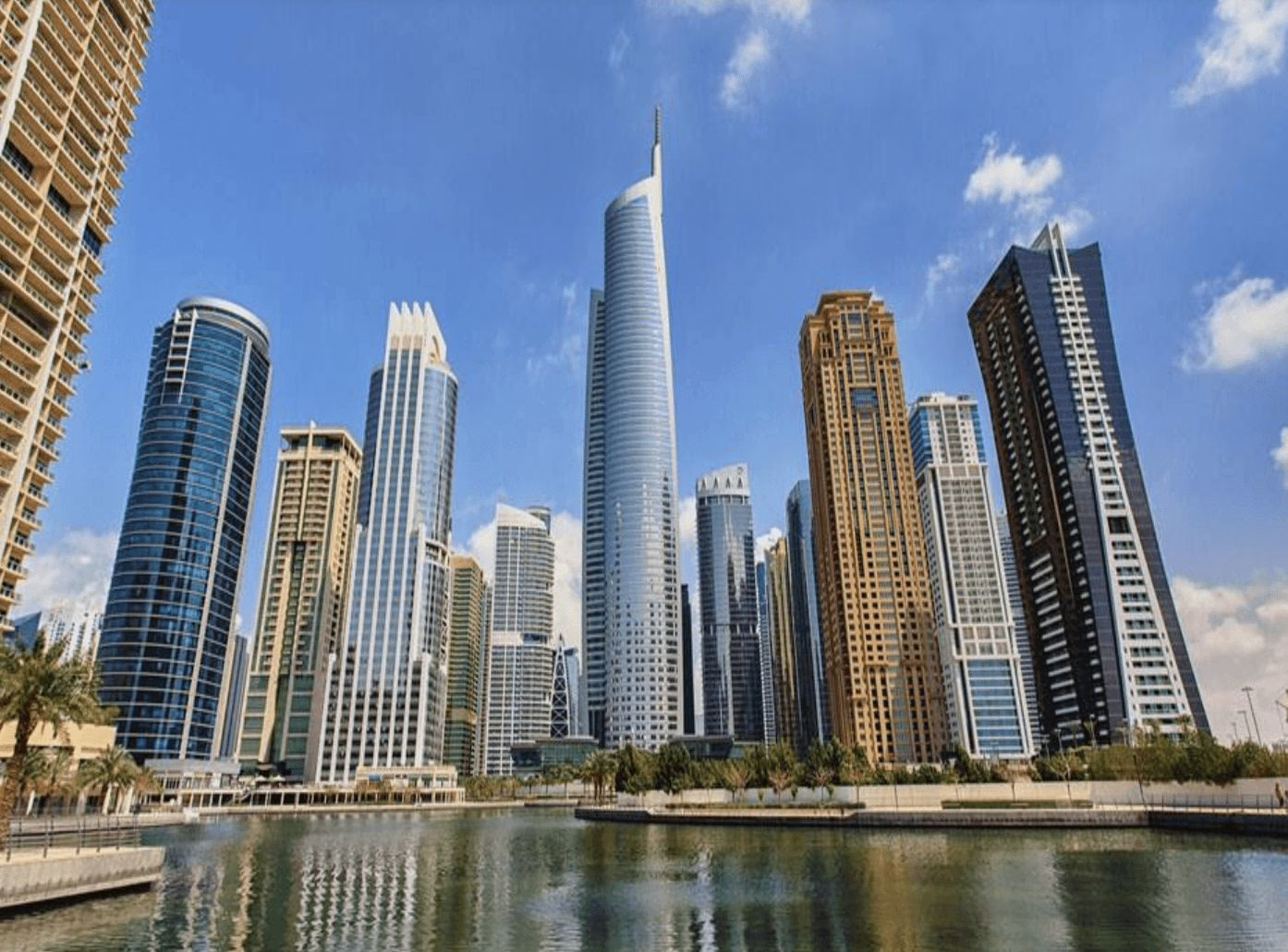
DMCC’s Role – Why Chinese Firms Are Choosing It
DMCC is more than just a free-zone; it is positioning itself as a strategic launch pad for global expansion, particularly for Chinese companies. Some key advantages:
-
Gateway to Middle East, Africa and beyond: Dubai’s geographic location and connectivity make it a natural hub for Chinese firms looking to reach wider markets.
-
Business-friendly environment: DMCC offers a regulatory, tax-efficient, business-friendly platform, which appeals to overseas companies.
-
Deepening value proposition: DMCC emphasises sectors such as digital infrastructure and innovation, which align with the strategic priorities of many Chinese firms. The roadshow in China (Yangtze River Delta: Shanghai, Suzhou, Hangzhou) is a clear example of DMCC proactively engaging Chinese business leaders.
-
Partnership with government-level trade flows: DMCC accounts for around 15 % of Dubai’s annual foreign direct investment (FDI) inflows and contributes around 7 % of the emirate’s GDP, underscoring its significance.
What Chinese Firms Are Doing in DMCC
The pattern of Chinese company activity within DMCC is notable in several ways:
-
Technology & innovation sectors: Many of the “over 130 Chinese technology companies” now host within DMCC are working in AI, blockchain, Web3 and digital infrastructure. Arabian Business
-
Global expansion strategy: Chinese firms are using DMCC to tap international markets. The district is marketed as “home to more than 1,000 Chinese companies … as we continue to refine our value proposition as the district of choice for ambitious Chinese firms expanding globally from Dubai,” according to Ahmed Bin Sulayem, Executive Chairman & CEO of DMCC.
-
Roadshow and engagement: DMCC’s “Made For Trade Live” (MFTL) roadshow in China attracted more than 750 Chinese business leaders for sessions focused on frontier technologies.

Strategic Implications for UAE–China Trade Relations
This development has broader implications beyond just business registration numbers.
-
UAE as China’s key partner: The fact that bilateral trade has exceeded US $102 billion positions the UAE as one of China’s major trading partners in the Gulf/Arab world.
-
Shift towards innovation-driven cooperation: Whereas earlier trade may have been dominated by commodities or goods, the increased presence of Chinese tech firms suggests the relationship is evolving into deeper collaboration on innovation, digital economy, infrastructure.
-
Role of free zones in strategic economic diversification: For Dubai and UAE in general, attracting Chinese firms supports diversification away from oil-driven sectors and strengthens the position of Dubai as a global business hub.
-
Geopolitical and investment dimensions: As Chinese firms establish regional bases, this further strengthens China’s presence in the Middle East ecosystem, and the UAE becomes a more prominent platform in Chinese global strategy.
What This Means for Entrepreneurs & Start-Ups in Dubai
For your audience of UAE-based entrepreneurs, startup founders and small-business owners, this trend opens up several opportunities:
-
Partnerships & supply-chain linkages: With more than 1,000 Chinese firms based in DMCC and active in sectors like AI/blockchain, there is potential for UAE-based start-ups to collaborate with or serve as local partners to those Chinese entrants.
-
Talent attraction and cross-border innovation: Chinese firms often bring technological capability, R&D, and global market experience—local firms can benefit from the ecosystem, knowledge transfer and network effects.
-
Service-layer opportunities: As Chinese firms establish operations, service needs will grow—legal, logistics, marketing, regional adaptation. UAE SMEs can position themselves to serve such inbound Chinese firms.
-
Leveraging trade flows: With UAE-China trade large and growing, entrepreneurs can explore export-import, logistics hubs, digital platforms connecting UAE and Chinese markets (especially via Dubai as a hub).
-
Location strategy: Choosing to locate in DMCC or working with firms in DMCC could provide access to global markets, Chinese investment linkages, and favourable regulatory/tax regimes.
Challenges & Considerations
While the trend is positive, there are several caveats entrepreneurs and policy-planners should keep in mind:
-
Competition for talent and resources: As more international firms arrive, competition for high-calibre talent, serviced office space, and other resources may increase in Dubai’s business ecosystem.
-
Regulatory alignment: Chinese firms often operate under different norms; local firms and regulators must ensure compliance, cultural fit, and smooth integration of cross-border operations.
-
Over-reliance on single markets: Even though China is a key partner, diversification remains important. UAE firms should avoid becoming too dependent on one country/partner.
-
Geopolitical risks: With China’s role in the global economy under increased scrutiny, firms operating cross-border may encounter regulatory, taxation or trade-policy risks.
-
Integration into broader UAE strategy: For UAE-based entrepreneurs, aligning with Chinese-business opportunities should dovetail with local strategy (e.g., Dubai’s 2040 master-plan, UAE’s AI strategy, logistics & trade platforms) rather than being isolated.
Conclusion
The 16 % growth in Chinese firms joining DMCC over the past year is a clear signal: Dubai is consolidating its role as a major gateway for Chinese business expansion, and the UAE–China trade corridor is shifting into higher-value territory — not just goods, but technology, innovation and global services. For you and your readers in UAE’s entrepreneurial ecosystem, this underscores a rich field of opportunity: partnerships, service innovation, cross-border linkages, and location advantage.
As China becomes the UAE’s largest trading partner and more than 1,000 Chinese firms make DMCC their home base, Dubai is positioning itself at the convergence of East-West innovation and commerce. The key question for entrepreneurs is: how will you plug into that evolving ecosystem?
DMCC Chinese companies, DMCC Dubai, UAE China trade 2025, Chinese businesses in Dubai, DMCC free zone growth, Dubai China trade relations, UAE China bilateral trade, Dubai business hub, Ahmed Bin Sulayem, Ahmed Bin Sulayem DMCC, Made for Trade Live China, Chinese investment in UAE, Dubai trade statistics 2025, DMCC technology companies, UAE–China economic relations, Chinese startups in Dubai
